
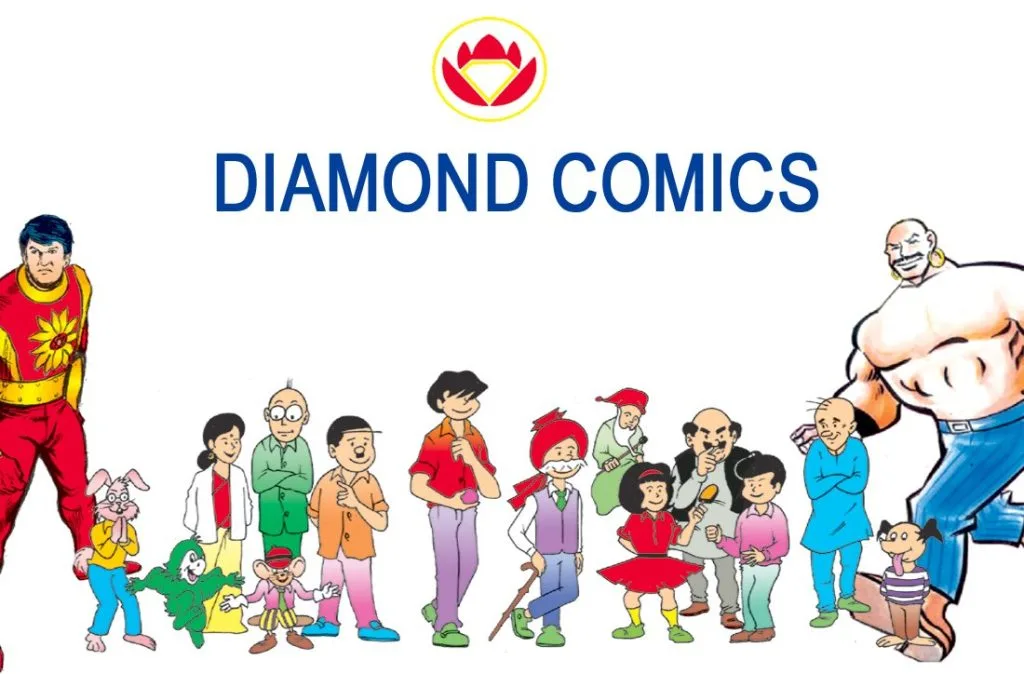
Diamond Comics CHARACTER OVERVIEW
Diamond Comics is not just a publishing house; within the landscape of Indian pop culture it functions almost like a collective character—a jovial, street-smart storyteller who grew up with the Indian middle class. Founded in 1978 and based in Delhi, Diamond Comics (P) Ltd. evolved from a modest comics line into one of India’s largest comic-book publishers and distributors. diamondcomicsindia.in+1
Through iconic creations such as Chacha Chaudhary, Billoo, Pinki, and later the comic versions of Motu Patlu, Diamond Comics helped define what “everyday Indian humour” looks like on the page. Wikipedia+3Wikipedia+3Wikipedia+3 Its books—often small in trim size, low-priced, and printed in multiple Indian languages—became a familiar presence at railway stalls, bus depots, school book fairs, and corner stationary shops across the country.
While many Indian publishers chased superheroes, mythology epics, or dark fantasy, Diamond carved a distinct identity around:
- Slice-of-life humour
- Satire of bureaucracy and social habits
- Child-centred mischief and neighbourhood antics
- Light adventure with gentle moral lessons
As a “meta-character,” Diamond Comics embodies the witty village uncle, the gossiping neighbourhood shopkeeper, and the streetwise prankster—all rolled into a single publishing personality.
QUICK CHARACTER DATA TABLE
| Attribute | Details |
|---|---|
| Name | Diamond Comics (P) Ltd. |
| Entity Type | Indian comic-book publisher / narrative universe |
| Parent Group | Bhartiya Bhandar Pustakalaya; associated with Diamond Group & Diamond Books Wikipedia |
| Founded | 1978 diamondcomicsindia.in+1 |
| Founders | Late Gulshan Rai Verma (key founding figure), with later leadership by Anshul Verma diamondcomicsindia.in+1 |
| Headquarters | Delhi, India diamondcomicsindia.in+1 |
| Primary Genres | Humour, satire, children’s adventure, licensed superhero reprints |
| Flagship Characters | Chacha Chaudhary, Sabu, Billoo, Pinki, Motu Patlu, Lambu-Motu, Rajan Iqbal, others Wikipedia+4Wikipedia+4Wikipedia+4 |
| Languages | Primarily Hindi, with English and several regional languages (Bengali, etc.) Wikipedia+2Wikipedia+2 |
| Status | Active publisher and distributor Wikipedia+1 |
| Signature Identity | Everyday Indian humour + “brain over brawn” problem solving |
ORIGIN STORY (FULL, EXPANDED)
In the late 1970s, Indian comics were in a formative phase. Mythology retellings and imported Western strips dominated. Into this ecosystem stepped Diamond Comics, founded in 1978 as part of a broader publishing enterprise tied to Bhartiya Bhandar Pustakalaya. diamondcomicsindia.in+1
The company’s origin story can be read like the first issue of a long-running series:
- Publishing Roots – The parent group already dealt with books and educational materials. Comics were initially just one more category—but they quickly became the most visible face of the brand.
- Partnership with Pran – The defining turning point was Diamond’s collaboration with cartoonist Pran Kumar Sharma, whose characters had started appearing in magazines such as Lotpot. Chacha Chaudhary, launched in magazine form in 1971, soon found a dedicated home within Diamond’s comic line, transforming into multi-issue digests and stand-alone titles. Wikipedia+1
- Birth of the “Diamond Universe” – Once Chacha Chaudhary found success, Diamond green-lit more Pran creations—Billoo (a TV-loving Delhi teen), Pinki (a mischievous five-year-old) and others. Wikipedia+2Wikipedia+2 These weren’t gods, superheroes, or alien warriors. They were ordinary Indians, rendered in exaggeration and caricature, yet rooted in lived reality.
- Affordable Mass Distribution – Diamond invested in a wide distribution network and low-cost formats—thin, colourful comics that could be impulse buys. Over time, the company became known as the largest comic-book distributor and publisher in India. diamondcomicsindia.in+1
- Licensing Western Icons – Alongside its homegrown heroes, Diamond acquired rights to publish Indian editions of famous characters like The Phantom, Mandrake the Magician, Superman, Batman, and Archie, often in Hindi and regional tongues. diamondcomicsindia.in+2phantomwiki.org+2 These crossovers made Diamond a one-stop shop where Indian kids could meet both local and global icons.
From this foundation, Diamond Comics grew into a universe-spanning entity: part neighbourhood jester, part cultural ambassador, part gateway to global comics.
PERSONALITY + TRAITS
Reading Diamond Comics as if it were a character, its “personality” emerges through the tone, themes, and visual style of its publications.
1. Wise but Playful
Like Chacha Chaudhary himself, Diamond embodies cleverness wrapped in humour. Plots often resolve not through epic battles, but through a witty twist, a simple moral, or a comic comeuppance for bullies and tricksters.
2. Middle-Class Grounded
The setting of most Diamond stories is the familiar Indian neighbourhood: cramped flats, roadside tea stalls, school playgrounds, and muddled government offices. The company’s narrative voice reflects the concerns of clerks, shopkeepers, students, and small-town families rather than billionaires or warriors.
3. Non-Violent Conflict Resolution
Diamond heroes are rarely lethal. Problems are handled through schemes, pranks, logic, and occasionally a well-timed slapstick gag. Even when villains like Raaka (Chacha Chaudhary’s immortal foe) appear, solutions lean toward containment, exile, or reform rather than outright destruction. Wikipedia
4. Inclusive & Multilingual
Through translations into numerous Indian languages and localized humour, Diamond behaves like a multi-lingual storyteller always ready to adapt its jokes for a new audience. Wikipedia+2Wikipedia+2
5. Resilient and Adaptive
Despite competition from TV, streaming, and games, Diamond continues to reissue digests, license digital versions, and align its IP with new media (such as animated adaptations). Wikipedia+2nickindia.com+2 This makes the “character” surprisingly resilient—aging but still active.
BIOGRAPHY (CHILDHOOD → TRANSFORMATION → EVOLUTION)
“Childhood” – Early Print Era (Late 1970s–Mid 1980s)
Diamond’s early years were its “childhood,” when it experimented with formats and characters:
- Entry through humour: Chacha Chaudhary strips, originally magazine features, were compiled into thin comic books. Wikipedia
- Exploratory distribution: The company tested railway stalls, city kiosks, and school book fairs to see where comics sold best.
- Visual identity: Cover art from this era emphasised bold, flat colours and simple compositions—Chacha whacking a goon with his stick, Billoo running from Colonel Three-Naught-Three, Pinki in mid-prank.
In these formative years, Diamond’s voice was still evolving, but the core motif—humour rooted in everyday life—was firmly planted.
“Adolescence” – Expansion & Icon Building (Late 1980s–1990s)
This period was Diamond’s energetic adolescence:
- Character roster growth:
- Billoo comics captured teenage mischief and Delhi suburb life. Wikipedia+1
- Pinki comics targeted younger readers with schoolyard antics and family gags. Wikipedia+2diamondbooks.in+2
- Side characters like Lambu-Motu, Raman, Raka, Sabu, and Rajan Iqbal expanded the ecosystem.
- Licensed titles: Diamond released localized versions of The Phantom, Mandrake, and DC characters, reinforcing its image as a bridge between global and Indian comics. diamondcomicsindia.in+2phantomwiki.org+2
- Digest culture: Fat “super digests” began compiling multiple stories, making long train journeys and holidays easier to survive for kids with limited pocket money.
During this phase, Diamond Comics matured into a “teenager” full of confidence, mixing humour, adventure, and imported superheroes.
“Adulthood” – Multimedia & Brand Diversification (2000s–2010s)
In adulthood, Diamond faced new challenges: satellite TV, cable, internet, gaming. Instead of vanishing, it diversified:
- TV adaptation: Chacha Chaudhary became a live-action TV series in 2002, with actor Raghubir Yadav in the title role. Wikipedia
- Animation era: A new animated Chacha Chaudhary series premiered in 2019, bringing the character to contemporary children via channels like Hungama/Disney. Wikipedia
- Motu Patlu phenomenon: While Motu Patlu originate from the magazine Lotpot, the duo’s explosive popularity via the 2012 Nickelodeon CGI series created fresh opportunities for comics, merchandise, and brand tie-ins that intersected with Diamond’s own humorous portfolio. Wikipedia+1
- Diamond Toons & Diamond Books: The broader Diamond Group expanded into books, magazines, and branded kids’ material, often reusing comic characters as mascots. Wikipedia
“Ongoing Life” – Digital Survival & Nostalgia (2020s–Present)
Today, Diamond exists in a hybrid state:
- E-commerce presence: The official site sells both new material and rare vintage stock, including Bengali Phantom issues and classic digests. diamondcomicsindia.in+1
- Nostalgia wave: Adults who grew up with Chacha, Billoo, and Pinki now buy collections for their kids—or for their own shelves.
- Cross-media synergy: Characters appear in licensing deals, digital campaigns, and event mascots, turning Diamond’s “family” of characters into enduring pop symbols.
POWERS & ABILITIES
Natural Abilities
- Mass Reach & Distribution Diamond’s greatest “power” has always been its distribution network, which allowed inexpensive comics to reach small towns, railway kiosks, and street stalls across India, making it the mainstream face of homegrown humour comics. diamondcomicsindia.in+1
- Relatable Humour Engine Its stories mine comedy from everyday life—traffic jams, runaway goats, petty officials, school pranks. This gives the brand a near-universal relatability that transcends region and class.
- Iconic Character Design
- Chacha Chaudhary: red turban, white moustache, waistcoat, walking stick. Wikipedia+1
- Billoo: mop of hair covering eyes, T-shirt and jeans, cricket bat. Wikipedia
- Pinki: short-haired girl in frocks or simple dresses, often with pet squirrel Kut-Kut. Wikipedia+1
- Multi-Generational Appeal Jokes operate at multiple levels: slapstick for young readers, gentle satire for adults. This allows Diamond to host a multigenerational fanbase.
- Language Flexibility Releasing comics in Hindi, English and regional languages lets Diamond “speak” many tongues, a key ability in a linguistically diverse country. Wikipedia+2Wikipedia+2
Tech / Mutant / Magic Sources
If we treat publishing infrastructure and licensing strategies as “external power-ups”:
- Licensed Western Superhero IP Publishing local editions of Phantom, Mandrake, Superman, Batman, Archie and others gave Diamond an infusion of global superhero prestige, similar to a character acquiring mystical artefacts. diamondcomicsindia.in+2phantomwiki.org+2
- Printing & Reprint Technology Efficient offset printing, reprint digests, and regional editions acted as Diamond’s “tech gear,” enabling massive print runs that kept older stories in circulation.
- Television & Animation Tie-Ins Live-action and animated Chacha Chaudhary shows, plus the Motu Patlu phenomenon, function like magical boosts that expanded Diamond’s universe into other dimensions (TV, streaming, YouTube). Wikipedia+2Wikipedia+2
- Digital & E-commerce Platforms The shift to an online store and digital promotions allows Diamond to keep selling “issues” long after the traditional newsstand market shrank. diamondcomicsindia.in+1
SUITS / WEAPONS / TOOLS / FORMS (DEEP BREAKDOWN)
Instead of a single hero’s gear, Diamond’s “equipment” consists of formats and brand forms.
1. Single-Issue Comics (“Floppies”)
- Slim, staple-bound, often 24–32 pages.
- Focus on one or two short stories featuring a single character.
- Functioned like quick “attacks”—highly portable and cheap.
2. Double & Super Digests
- Thick bound volumes compiling several stories or crossovers (often 4-in-1 or more). diamondcomicsindia.in+2diamondcomicsindia.in+2
- Became long-range “weapons” for train journeys and vacations.
- Many readers’ strongest memories of Diamond come from these brick-like digests.
3. Character-Branded Series
Each major character behaves like a “form” Diamond can take:
- Chacha Chaudhary series – Brain-over-brawn episodes with Sabu and villain Raaka. Wikipedia+2diamondcomicsindia.in+2
- Billoo series – Youth comedy, sports, and neighbourhood rivalries. Wikipedia+1
- Pinki series – Mischief, family jokes, school antics. Wikipedia+2diamondbooks.in+2
- Lambu-Motu & Others – Buddy humour, light adventure. diamondcomicsindia.in
These lines function like alternate costumes that Diamond can “wear” while keeping its core identity.
4. Licensed Superhero Lines
- Phantom, Mandrake, Superman, Batman, Archie, etc., published in Indian formats. diamondcomicsindia.in+2phantomwiki.org+2
- Introduced Indian readers to global superheroes while filtered through Diamond’s distribution and pricing.
5. Coffee-Table Collections & Premium Editions
Recent years saw hardbound or large-format volumes (e.g., “101 Coffee Table Book” editions for Billoo or Pinki). diamondcomicsindia.in+1
These are like ceremonial armour—used not for street fights but for commemorative occasions.
6. Ancillary Tools
- Merchandise: Posters, school products, activity books.
- Educational Tie-Ins: Comics used to teach road safety, health awareness, etc.
- Brand Extensions: Diamond Toons as a label for children’s IP and multimedia.
FULL TIMELINE APPEARANCES (COMICS + MOVIES + SERIES)
(Selected key milestones rather than exhaustive issue listing.)
1970s
- 1971 – Chacha Chaudhary debuts in the Hindi magazine Lotpot. Wikipedia
- 1973 – Billoo appears in early strip form; later associated with Diamond Comics. Wikipedia+1
- 1978 – Diamond Comics is formally founded in Delhi as a comics publisher. diamondcomicsindia.in+1
1980s
- Consolidation of Chacha Chaudhary, Billoo, Pinki into distinct Diamond titles. Wikipedia+2Wikipedia+2
- Start of Indian-language Phantom and Mandrake lines. phantomwiki.org+1
1990s
- Rise of digest culture: multi-story volumes and 4-in-1 editions. diamondcomicsindia.in+2diamondcomicsindia.in+2
- Continual publication of homegrown and licensed characters across states.
2000s
- 2002 – Chacha Chaudhary live-action TV series debuts on Sahara One. Wikipedia
- Diamond transitions into cross-media licensing, including early animation plans for Chacha and Pinki. Wikipedia+1
2010s
- 2012 – Motu Patlu animated TV series—based on characters from magazine Lotpot—launches on Nickelodeon and becomes a cultural phenomenon. Wikipedia+1
- Ongoing reprints and new digests of classical Diamond characters. diamondcomicsindia.in
- 2019 – Animated Chacha Chaudhary series begins airing, bringing Diamond’s flagship character to a new generation. Wikipedia
2020s
- Diamond’s official store and associated platforms sell both new comics and rare vintage issues, including Phantom, Mandrake, Chacha, Billoo, Pinki, Lambu-Motu and others. diamondcomicsindia.in+1
- Ongoing presence of Motu Patlu on TV and digital, keeping the humour-comic tradition in mainstream kids’ media. Wikipedia+1
MAJOR VILLAINS & RIVALRIES (META-LEVEL)
Diamond Comics as a “heroic entity” faces several broad antagonists:
1. Media Displacement
Television, then cable, followed by smartphones and games—each new wave of media competition challenged the relevance of low-cost physical comics.
2. Piracy & Unofficial Scans
Unlicensed photocopies and digital scans spread widely, sometimes helping nostalgia but hurting sales.
3. Market Fragmentation
The rise of international children’s brands, manga, and licensed movie tie-ins fragmented attention that once belonged almost entirely to domestic humour comics.
4. Rival Publishers
- Raj Comics with superhero epics (Nagraj, Super Commando Dhruv).
- Tulsi Comics with dark fantasy and monster heroes.
- Amar Chitra Katha with mythology and history.
Instead of direct “superhero vs superhero” fights, these rivalries exist as differing visions of what Indian comics can be.
POPULAR COMIC ARCS (WITH DESCRIPTION)
Diamond doesn’t structure stories into long “event crossovers” the way American superhero publishers do, but several character-centric patterns stand out.
1. Chacha Chaudhary vs Raaka Cycle
A semi-recurring saga pits Chacha and Sabu against Raaka, an immortal dacoit accidentally empowered by a mislabeled immortality potion. Wikipedia
- Themes: Immortality as curse, cleverness vs brute strength.
- Typical resolution: Sabu physically subdues Raaka; Chacha devises ways to exile him (ocean depths, space, etc.) without being able to kill him.
2. Billoo and Colonel Three-Naught-Three
Colonel Three-Naught-Three constantly tries to keep Billoo away from his daughter Jozi.
- Themes: Youth vs authority, middle-class aspirations, romantic comedy. Wikipedia
- Structure: Short gags where Billoo’s resourcefulness allows him to outwit the Colonel or escape his threats.
3. Pinki’s Neighbourhood Chaos
Pinki’s episodes revolve around her mischief backfiring yet ultimately resolving problems for neighbours or classmates.
- Themes: Child innocence, gender expectations, community life. Wikipedia+1
- Impact: Introduced a bubbly, assertive girl protagonist at a time when many comics still centred on male heroes.
4. Lambu-Motu vs Dracula Mini-Franchise
A notable sub-line focuses on Lambu-Motu encountering various incarnations of Dracula and horror motifs, blending comedy with kid-friendly horror. diamondcomicsindia.in+1
5. Licensed Crossovers
Diamond’s Phantom, Mandrake, and Superman reprints sometimes appeared in gift packs and digests alongside Indian characters, creating a symbolic “shared universe” in readers’ minds even when stories were originally unrelated. diamondcomicsindia.in+2thephantom.fan+2
ALTERNATE UNIVERSE VARIANTS
While Diamond doesn’t formally operate a multiverse, its characters have appeared in varied media universes that function as alternate versions:
- Magazine Strip Universe The early Lotpot incarnations of Chacha Chaudhary, Motu Patlu, and others exist in a slightly different tone, with looser continuity and shorter gag strips. Wikipedia+1
- TV Live-Action Universe The 2002 Chacha Chaudhary TV series portrays characters with realistic sets and human actors; humour leans towards sitcom style. Wikipedia
- Animated Universe The 2019 Chacha animated series and Motu Patlu CGI show represent high-energy, kid-targeted universes with brighter colours and more slapstick. Wikipedia+1
- Educational/Brand Mascot Universe In road-safety or social-campaign comics, characters break out of their standard narrative worlds to talk directly to the reader, forming a quasi-meta universe.
MCU / ANIME / FILM HISTORY COMPARISON
Comparison to the MCU
- Scale: MCU revolves around interconnected superhero epics; Diamond’s universe is smaller in stakes, focused on domestic life.
- Tone: MCU mixes humour with high-budget action; Diamond leans 90% humour, 10% mild adventure.
- Hero Type: MCU heroes wield advanced tech or powers; Diamond champions are ordinary humans (or Burly aliens like Sabu) relying on wit or slapstick.
In Marvel terms, Diamond characters are closer to neighbourhood-level heroes like Spider-Man’s supporting cast—except entire stories stay at that modest scale.
Comparison to Anime
- Slice of Life: Pinki and Billoo resemble characters from slice-of-life school anime—light conflicts, comedic misunderstandings.
- Super-Deformed Comedy: Exaggerated facial expressions and cartoon physics align with gag anime aesthetics.
- Non-Serialized: Like many comedic anime, there’s minimal long-term continuity.
Film History
Though Diamond’s characters haven’t yet birthed a sprawling cinematic universe, they’ve flirted with film and TV:
- Live-action TV show for Chacha Chaudhary. Wikipedia
- Animated Chacha Chaudhary and Motu Patlu shows, with occasional TV movies and specials. Wikipedia+1
- Plans announced in the late 2000s for feature films combining Chacha, Pinki, and Sabu. Wikipedia+1
These efforts function like limited film crossovers rather than a full-scale cinematic franchise.
KEY FEATS, FEATS VS OTHER HEROES
Key Feats of Diamond Comics (Meta-Level)
- Nationwide Reach Achieved status as the largest comics distributor and publisher in India, with presence in multiple languages and retail channels. diamondcomicsindia.in+1
- Creation of Iconic Humour Heroes Gave enduring life to characters like Chacha Chaudhary, Billoo, and Pinki, who remain among the most recognisable Indian comics figures decades after their debut. Wikipedia+2Wikipedia+2
- Cross-Cultural Bridge Brought The Phantom, Mandrake, and major Western superheroes to Hindi and regional readers, effectively serving as India’s “gateway” to global comic icons. phantomwiki.org+2thephantom.fan+2
- Survival Across Media Revolutions Endured transitions from print-only to TV, then to digital and e-commerce, still selling classic content in the 2020s. diamondcomicsindia.in+2diamondcomicsindia.in+2
Feats vs Other Indian Comic “Heroes” (Publishers)
- Against Raj Comics (Superhero Titan):
Raj dominates superhero myth and large continuity events; Diamond counters with grounded humour and multi-age accessibility. - Against Amar Chitra Katha (Myth & History Sage):
ACK focuses on educational and mythological narratives; Diamond’s strength is informal comedy that critiques everyday life. - Against Tulsi Comics (Dark Fantasy Anti-Hero):
Tulsi embraced horror and tragic antiheroes; Diamond’s comparatively light, optimistic tone offers family-friendly contrast.
In a figurative “versus” scenario, Diamond may not deliver cosmic battles, but it consistently wins on accessibility and recognizability across generations.
DEATH / RESURRECTION / LEGACY
Death?
Unlike some contemporaries that folded completely, Diamond Comics never truly “died.” However, its mainstream visibility dipped as television and global franchises rose. The once omnipresent railway-stall comics became rarer, giving an illusion of decline.
Resurrection
The brand’s resurrection is less dramatic than a superhero returning from the grave, but it’s real:
- Revival of classic digests and repackaged collections (e.g., Super Digests, Coffee Table Books). diamondcomicsindia.in+2diamondcomicsindia.in+2
- Active online store and social media presence that sell new prints and rare vintage stock. diamondcomicsindia.in+1
- New animated adaptations keeping the IP in circulation. Wikipedia+2Wikipedia+2
Legacy
Diamond’s legacy can be summarised in three dimensions:
- Cultural Memory For many Indians who grew up between the 1980s and early 2000s, Diamond comics are tied to childhood: reading by tube-light, swapping issues in school, buying from footpath vendors.
- Humour Aesthetic Diamond helped define the look and rhythm of Indian gag cartoons—dialogue-heavy panels, quick punchlines, exaggerated but recognisable character designs.
- Template for Domestic IP In an era before “IP” became a business keyword, Diamond proved that homegrown characters could become merchandising and screen properties.
HIDDEN & RARE TRIVIA
- “Brain Faster than a Computer” The famous tagline about Chacha Chaudhary’s brain being faster than a computer became so widely quoted that it entered colloquial speech in India. Wikipedia
- Hair-Obscured Eyes of Billoo Billoo’s eyes are nearly always hidden by his hair, a deliberate stylistic choice that makes his expressions more universally cartoonish. Wikipedia+1
- Pinki’s Pet Squirrel Pinki’s squirrel, Kut-Kut, is one of the rare recurring animal sidekicks in Indian gag comics and often gets its own mini-gags. Wikipedia+2diamondbooks.in+2
- Regional Phantom & Mandrake Diamond’s Bengali and Assamese Phantom issues, now rare, are highly prized by collectors and evidence of how deeply Western heroes penetrated regional markets via Diamond. diamondcomicsindia.in+1
- Diamond Toons as Separate Brand “Diamond Toons” appears as a distinct label for kids’ products and digests, effectively serving as a younger “alter-ego” of the main publishing entity. BigBasket+1
- Link with Educational Packs The official store sells curated packs of Amar Chitra Katha and basic education comics, positioning Diamond as a facilitator of both fun and learning. diamondcomicsindia.in
TIMELINE / FORM / SUIT EVOLUTION TABLE
| Era | Form / “Suit” | Key Characteristics | Narrative Significance |
|---|---|---|---|
| Late 1970s–Early 1980s | Foundational Humour Floppies | Early Chacha/Billoo/Pinki issues, low-cost paper, simple cover art; limited but growing distribution | Establishes Diamond’s core identity as a humour publisher |
| Mid 1980s–1990s | Expansion & Licensed IP Suit | Launch of digests, introduction of Phantom/Mandrake/DC/Archie lines, multilingual editions | Diamond becomes nationwide bridge between Indian and global comics |
| 2000s | Multimedia & Brand Suit | Live-action Chacha show; enhanced digests; early brand licensing and cross-promotions | Demonstrates adaptability to TV and merchandise |
| 2010s | Digital-Linked Hybrid Suit | Animated Chacha; Motu Patlu boom; increased nostalgia reprints; emergence of Diamond Toons | Reconnects with children while re-engaging adult fans |
| 2020s–Present | E-Commerce & Legacy Suit | Official webstore; vintage sets; coffee-table editions; social-media presence | Reinvents Diamond as both living publisher and heritage brand |
CONCLUSION — FUTURE SCOPE & LEGACY
Diamond Comics may not command the global visibility of Marvel or DC, but within India it plays an irreplaceable role: it is the archivist of middle-class laughter, the chronicler of street-level absurdities, and the guardian of some of the nation’s most beloved comic icons.
Looking ahead, Diamond’s future scope includes:
- Digital Archives & Apps – Curated subscription libraries or apps could introduce classic material to smartphone-native readers.
- New Animation & Short-Form Content – Web-shorts, YouTube mini-episodes, and social-media strips could revitalise Billoo and Pinki for a new generation.
- Graphic Novel Re-imaginations – Longer, thematically rich volumes that update classic characters while preserving their humour.
- Crossovers with Modern IP – Collaborations with contemporary Indian animations (like Motu Patlu, Little Singham, etc.) or even educational content.
Yet even without radical reinvention, Diamond’s existing legacy is immense. For millions, its comics are shorthand for a specific kind of warmth: a world where bullies get outsmarted, elders make dry jokes, and problems are solved not with punches or lasers, but with a cleverly worded one-liner and a twinkle in the eye.




Leave a Comment